
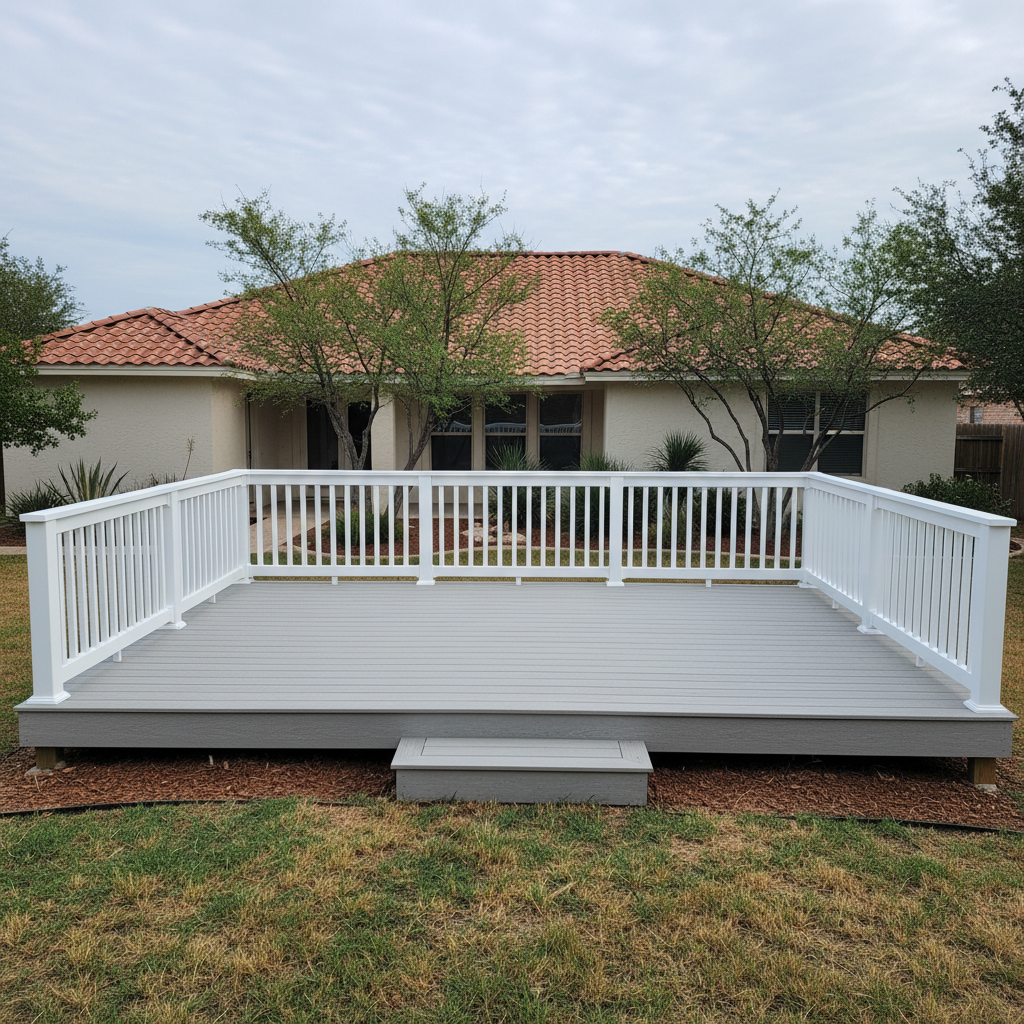
Mission gets a lot of deck builders knocking on doors in the spring, right before everybody wants to be outside for the season. Some of them are good at this. Some of them are a truck, a ladder, and a Facebook page. Telling the difference before you sign anything is the whole job of this post.
A deck is not a patio. It's a structure attached to your house, carrying live load, sitting on footings, and taking on the Rio Grande Valley sun and the August downpours. Get the footings wrong and you won't know it for two or three years, when the clay under them has shifted enough to show up as a rail that leans or a board that's stopped sitting flat.
What the clay soil here actually does
Most of Mission and the surrounding towns sit on heavy clay, the Hidalgo and Willacy series soils that show up on just about every soil survey for the county. That clay swells when it's wet and shrinks hard when it's dry, and in a dry August it can crack open an inch or more at the surface. A footing that's just poured 10 inches deep and called good will move with that cycle. A builder who knows the ground here will dig footings down past the zone where the clay is doing most of its swelling, often 18 to 24 inches depending on the soil report and the post load, and will size the concrete pad wide enough to spread the weight instead of punching down into soft clay underneath.
Ask any bidder how deep they're going and why. If the answer is a shrug, that's your answer too.
Permits aren't optional, and skipping them costs you later
The City of Mission requires a building permit for most attached decks, and depending on footprint and height, detached ones too. An inspector will generally want to look at the footing holes before concrete goes in, and at the ledger board attachment before the decking goes down, since a ledger that's lag-bolted into rim joist without flashing is one of the most common ways a deck pulls away from a house. If you're in one of the newer subdivisions out toward Alton or Palmview, there's a decent chance an HOA is involved too, with its own rules on setback, height, or even railing style.
A contractor who tells you permits aren't necessary, or that they'll "handle it" without ever pulling one, is setting you up to either tear the deck out when you sell the house, or to deal with an uninsured, unpermitted structure if something fails and you try to file a claim. Ask to see the permit number once it's issued. It should exist.
Materials that hold up to this climate
Mission summers run 95 to 100-plus from June through September, with the humidity to match, and hurricane season officially runs June 1 through November 30 even though most years it's just heavy rain and wind rather than a direct hit. That combination is hard on wood. Pressure-treated pine is the standard framing material here and it's fine, as long as it's rated for ground contact where it touches footings and as long as the moisture content has dropped to around 15% or less before anyone stains or seals it. Stain applied to wet lumber doesn't cure right and peels within a season.
For the decking surface itself, a lot of homeowners here are moving to composite, partly because real wood decking takes a beating from UV exposure this intense and needs restaining every two to three years to keep up. Composite costs more up front and doesn't need that maintenance cycle, but it still expands and contracts with heat, so the gapping between boards matters. A builder who's installed composite here knows to leave roughly 1/8 inch between boards in summer installs to account for that movement. One who treats composite like wood and butts it tight is going to hand you a buckled deck by next July.
What an honest quote looks like
A real bid breaks out materials and labor separately, names the species or brand of lumber and decking, and states the footing depth and post spacing, usually 16 inches or 24 inches on center depending on the joist span. It should also say who's pulling the permit and who's covering inspections.
A bid that's just one number on a napkin isn't necessarily a scam, but it tells you the builder isn't used to being checked on. Get at least two quotes if the first one feels vague. The gap between a careful bid and a rushed one is usually bigger than homeowners expect, sometimes 30% or more, and it's almost always explained by what's happening underground where you can't see it.
Red flags worth walking away from
- No local address or a phone number that goes to voicemail every time.
- Wants the full payment up front, before any material is on site.
- Can't tell you their general liability and workers' comp coverage without digging for it.
- Talks you out of a permit, or says the inspection "usually gets skipped."
- No answer on footing depth, post spacing, or how they're flashing the ledger board.
None of these alone is fatal, but two or three together usually means you're looking at a deck that'll need rebuilding in five years instead of lasting twenty.
If you're weighing a new build, a repair on an older deck, or just want someone to look at what's there before you spend money on staining or railing, that's the kind of walkthrough Oakmont Deck Company does around Mission and the nearby towns, footing depth and permit paperwork included.